
What a REMS scan is
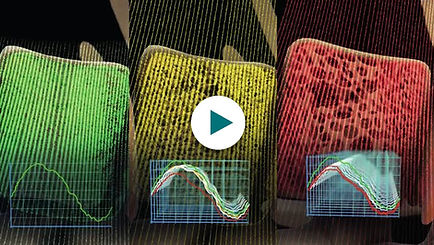
REMS stands for Radiofrequency Echographic Multi Spectrometry. Rather than passing X-rays through the body, it sends ultrasound into the bone and analyses the raw signal that comes back. Different bone structures return different signal patterns, and those patterns are compared against reference models to produce your results.
With no radiation, there is no limit on how often you can be scanned. So we can measure again in six months and see whether anything has actually changed, instead of taking one reading and waiting a year for the next.
We use the EchoLight system, which is FDA cleared.

How REMS works
Three stages, all of them happening while you lie still for about twenty minutes.
Reading the raw signal is the part that distinguishes REMS from older ultrasound bone testing, which measured at the heel or wrist. REMS scans the hip and spine — the same sites DXA uses, and the sites where fractures actually matter.
REMS and DXA: how they compare
DXA is the long-standing standard for bone density testing and remains the reference most physicians work from. REMS is a newer, ultrasound-based approach. They answer overlapping questions in different ways.
A comparison of the two main approaches to bone density testing.
90%
of DXA scans are affected by inaccuracies from patient positioning, body composition or technical error.
30%
more accurate than DXA at predicting fracture risk, by assessing bone quality alongside density.
9x
higher fracture risk identified in patients with spinal Fragility Scores above the study cut-off, a distinction not captured by DXA T-scores.
One thing worth understanding: REMS and DXA measure bone differently, so their T-scores are not directly interchangeable. If you have had a DXA before, bring the report. We will read your REMS result alongside it rather than treating one as a correction of the other.
What your scan measures
You leave with four measurements and an explanation of each.
Bone mineral density
How much mineral your bone contains, reported as a T-score against a healthy reference range for your age and sex.
Fragility score
A measure of bone quality — the internal structure of the bone. Two people with the same density can have varying bone strength.
Five-year fracture risk
An estimate of your likelihood of fracture over the next five years, which is the number that actually matters day to day.
Body composition
Fat mass and lean mass distribution, which give a fuller picture of musculoskeletal health with bone measurements.
Density tells you how much bone is there. Quality tells you how well it is put together. Measuring both is the reason a scan here gives you more to work with than a density figure alone.
What the research shows
REMS is newer than DXA, but it is not unstudied. It has been assessed in multicentre trials, validated against DXA, and reviewed by the European Society for Clinical and Economic Aspects of Osteoporosis.
The research worth knowing about:
-
It predicts fractures, not just density. A five-year prospective follow-up study found that the REMS T-score was an effective predictor of incident fragility fractures. Adami et al., Bone, 2020
-
It agrees closely with DXA. A multicentre study across more than 1,900 women found high correlation between bone mineral density measured by REMS and by DXA, at both the lumbar spine and the femoral neck. Di Paola et al., 2019; Cortet et al., 2021
-
It holds up where DXA struggles. A systematic review found REMS had enhanced diagnostic capability in cases where DXA spine measurements were impaired by artifacts such as vertebral fractures, deformities, osteoarthritis, or vascular calcifications — and that its repeatability was comparable to or better than DXA's. Icătoiu et al., 2025
-
The fragility score adds something density misses. A five-year study of 1,989 patients found the REMS fragility score outperformed both REMS and DXA T-scores at predicting fractures, in women and men alike. Patients with a spinal fragility score above the study's cut-off carried a ninefold higher risk of fragility fracture. Pisani et al., 2023
REMS has also been studied in populations where repeat X-ray testing is a problem — people with diabetes, rheumatoid arthritis, osteogenesis imperfecta, anorexia nervosa, and patients needing frequent monitoring.
Insights from leading experts
Specialists explaining what REMS measures and how it is used in practice.
.jpg)

.jpg)
What to expect
Plan for about 30 to 45 minutes from start to finish. There’s a little preparation involved, including choosing the right clothing for your appointment.
Who should get a bone density scan
Bone loss has no symptoms. It is silent until something breaks, which is why screening rather than waiting is the point. A scan is worth considering if you:
-
Are postmenopausal, or went through menopause early
-
Are over 50 and have broken a bone since then
-
Have a parent or sibling who fractured a hip or has osteoporosis
-
Have taken oral steroids for three months or longer
-
Take long-term acid reflux medication, anti-seizure medication, or thyroid hormone replacement
-
Have lost height, or noticed a change in your posture
-
Have rheumatoid arthritis, coeliac or Crohn's disease, hyperthyroidism, diabetes, or chronic kidney disease
-
Have been diagnosed already and want to track whether treatment is working
Men are included in all of the above. Osteoporosis is often treated as a women's condition, and men are consequently screened far less often than they should be.
Cost and insurance
A REMS scan is $299, covering both hips and the spine, with results reviewed with you the same visit.
REMS is newer than DXA and is not currently covered by insurance, so scans are self-pay. That has an upside worth knowing: there is no referral to chase, no prior authorisation, and no waiting for approval. You book, you scan, you get your results.